Report: Expanding DERs Could Avoid $600B+ in US Grid Costs, Cut Household Bills through 2050
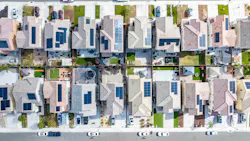
The rise of distributed energy resource (DER) assets, such as solar, battery storage and managed EV charging, is breaking down barriers to next-generation frameworks and policies, ultimately unlocking these applications across multiple networks.
Deploying these DERs across multiple networks, such as residential, commercial and industrial customers, could help avoid an estimated $614 billion in U.S. power system costs through 2050. According to a new report by the global consulting firm The Brattle Group for The Pew Charitable Trusts, broader DER adoption across these networks nationwide could offset roughly half of projected household electricity bill increases, apart from those related to inflation.
In the firm’s report titled “The National Case for a More Distributed Power Grid: New Evidence on Affordability and Demand Growth,” researchers studied the rising impacts on the U.S. power system through 2050 under a nationwide scenario. In this scenario, DER deployment expands to levels already observed in key U.S. markets.
Addressing grid strain: DERs balancing historic demand
Between now and 2027, U.S. electricity generation is expected to surge to historic highs. According to the Energy Information Administration (EIA), the projected 2.2% increase will result in a record energy output equivalent to an average continuous grid load of 498.63 GW (4,368 BkWh). An additional 1.7% growth is anticipated next year.
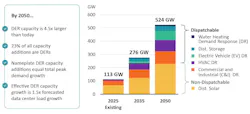
The joint Pew and Brattle Group study detailed that leveraging DERs located close to electricity users is crucial to supporting energy affordability and meeting rising demand.
U.S. utilities have reportedly proposed investing $1.4 trillion through 2030 in infrastructure upgrades and DER projects. The aging U.S. power grid is leading many states and power generators to take action and seek off-grid solutions to boost their distributed energy resources.
The Platte River Power Authority, a community-owned power utility provider in Colorado, is one example of these investments at work, with expanded plans for a virtual power plant (VPP) with software company EnergyHub. The growing need for a VPP is part of efforts to provide dispatchable, on-demand power to support its increasingly renewable energy portfolio. DERs work in tandem with VPP aggregating technology to help feed excess energy back to the grid or reduce load where needed.
DER participation in programs like VPPs provides direct financial benefits for customers, not large-scale power developers, allowing them to earn direct compensation for services they provide to the grid.
Scaling grid-edge flexibility through DERMS
Expanding DER deployments would reportedly shift roughly 105 GW of storage capacity from centralized utility-scale projects to localized distributed storage managed by distributed energy resource management systems (DERMS) for grid-edge flexibility.
The Brattle study concluded that removing key policy barriers to DER deployment and technologies in its research scenario would more than quadruple U.S. DER capacity. By doing so, it reduces the risk of excessive capital expenditures and the cost of overbuilding conventional energy infrastructure driven by electricity demand uncertainty.
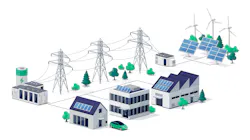
In this scenario where anticipated load growth falls short, greater reliance on DERs would reportedly reduce overbuilding energy infrastructure costs by $33 billion (40%) between 2030 and 2040. Addressing regulatory hurdles, the firm noted, could add over 400 GW of grid capacity by 2050—the equivalent of nearly one-third of the country’s entire existing power generation fleet today.
“Many homes and businesses already have technologies that could help the grid meet rising demand, and adoption of those technologies will continue to grow. The opportunity is to treat them as resources in utility planning rather than leave their capabilities untapped,” said Ryan Hledik, a Brattle principal and report coauthor, in a statement. “At scale, DERs could avoid or defer a portion of U.S. infrastructure investment needs, reduce pressure on household bills and give utilities more flexibility in the face of uncertain demand.”
Broader decarbonization pathways: Reducing system expenditure, CO2 emissions
The firm explains that rapid demand growth amid AI and data centers is colliding with rising infrastructure costs, long development timelines, affordability pressures and the continued need to decarbonize the power system.
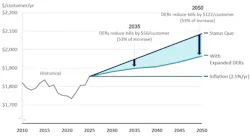
To mitigate this, DER deployment could reportedly enable an annual reduction of $122 in average household electricity bills by 2050, offsetting roughly half of the projected bill increases assumed by the inflation rate.
In addition, researchers highlighted that expanding DER deployment could avoid roughly 70 GW of projected net gas additions. It would reportedly mark a 22% reduction equivalent to 175 natural gas-fired plants nationally. Decreasing carbon emissions (CO2) is highly critical in this scenario, Brattle Group adds, detailing the deployment and integration of EVs.
According to the EIA, CO2 emissions are on the rise again in the U.S. Despite two decades of intermittent but steady declines, EIA data show a 2% rise in 2025. Electricity sector growth and coal dependency are reportedly playing critical roles in this rise.
The Brattle Group noted that DERs would directly reduce cumulative power sector CO2 emissions by an estimated 3% through 2050 in its research scenario. By requiring a carbon-free generation fleet by 2050, expanded DERs could offset roughly 175 GW of utility-scale capacity and lower annual generation costs in 2050 by $45 billion (20%), making a decarbonized power system less costly.
Ambitious but feasible adoption of DERs could reportedly address these overall challenges and deliver over half a trillion dollars in cost savings to the grid and customers across multiple networks over the next 25 years.
“At a time of historic demand from data centers, new manufacturing and electrification, DERs can provide a significant new energy supply if barriers to their adoption are removed,” said Maureen Quinlan, who leads Pew’s work to decarbonize the grid. “This report underscores how pragmatic policy changes that enable DER technology can save billions, cut emissions and help build a more affordable, reliable and flexible grid that meets today’s and tomorrow’s energy needs.”
About the Author
 Eric Moody
Staff Writer
Related
 der_dreamstime
 vpp_dreamstime